
Research – How important is it?? (and an update on Cairo)
Academia isn’t really my thing so the concept of research has always seemed a bit dry to me. I imagine sifting through piles of paper, reading books, surfing the net ….. none of which I am good at. I can do it but it is a chore not a pleasure. Yvette Cowles researched everything, checked her sources, gathered information and facts like a squirrel storing nuts. Whether teaching a workshop or designing the JWAAD courses, her research was far reaching and intensive. The level of detail she went into and obscure footage she sourced for the History and Culture course brought the past to life. What could have been a dry subject became a fascinating insight into past lives.
My area of expertise is ‘Cairo Today’. This is the sort of research I enjoy …. getting out and about on the streets of Cairo, chatting with people, going to different clubs. Part of what I do is take groups to Cairo and when Irene Tormo requested I do a Cairo Nightlife trip focussing on the clubs, I was delighted. Often if groups are sightseeing they do not have the energy to do many late nights as well.
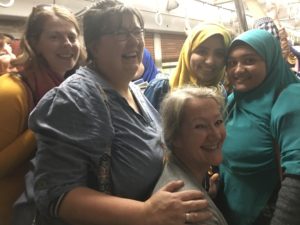
On Cairo metro in womens carriage
We stay in a local 3 star hotel in Downtown Cairo. I have been asked to base trips at 5 star hotels but my USP is discovering the real Cairo – not being insulated from it in a 5 star hotel that could be in any country. We use taxis and the local metro system. I occasionally hire a bus for the group but for local trips we use taxis. You rarely see foreigners on the metro – often school girls or young women practice their English on us. We can practice our Arabic. Did you know the Cairo metro has women only carriages – a concept they should bring in in rush hour in the UK. Far nicer to be pressed into a bunch of women than men!!

Amthal at the Fairmont
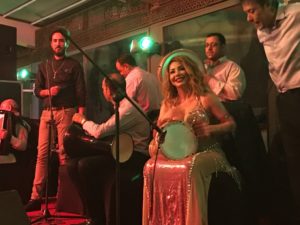
The multi talented Soraia
We saw a whole host of shows ….. from Downtown cabarets with lots of reverb and a range of dancers …. but the best singer ever. He is the reason for going and the girls had a great time boogying the night away. The best night in town without a doubt is Thursday night at the Fairmont. The amazing Amthal (pronounced Amsal) sings a range of old classics and has a full band. It is worth the extortionate minimum charge just to hear her. Then Soraia Zaeed. I have known Soraia since she first came to Cairo and danced at a tiny restaurant called the Aladin. Now she is a Cairo star. Her dance show is varied, her costumes fabulous and, who knew, she can even play the tabla!! I went to her dressing room after and we caught up on gossip then she and Amthal had their photos taken with the girls.
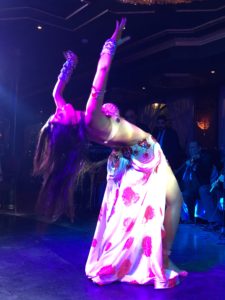
Sahar – an electric performance
We got to see Sahar twice. Sahar was the last Egyptian dancer in Dinas competition – she came third loosing out to Ala Kushnar and Soraya (a different one). The competition raised their profile and put Sahar into a new league. I have followed her rise to stardom with interest. She can be seen on the Blue Nile (I love this place and it is a great intimate setting for a dancer) and at the Ritz Carlton which is where we went this time. A new 5 star venue – outdoors. Unfortunately the day we went it rained. The stage was moved under cover and the show went on. A much more difficult space as the energy diffuses out of doors and it is hard to create an impact. Then I also got to see her at Randas opening show on the Maxim. She was electric. Fabulous – and some amazing costumes – 2 of them (my favourites by Eman Zaki). Her saidi and baladi sets left me speechless.
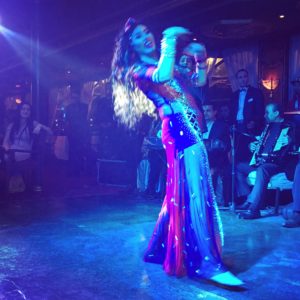
Randa Kamel – of course!
The end of the Cairo nightlife week (we saw: Brenda, Sahar, Aziza, Lucy, Christina, Soraia + several other unknown dancers), several of the girls transferred to the Barcello hotel for the Randa Kamel of Course week. I joined them at the opening and Randa was on fire. She gave us her all – she is like an animal in its prime. The power and energy behind her performance are fantastic. Then she finished with a fun fellahi set which was playful and had us all laughing out loud. Randa is a dancers dancer. She puts on a great show, has technique to die for and a great band behind her.
So, is research a chore? Not this sort of research for sure. Is it important? Vital. Whether it be historic research or current research, the more informed you are, the more depth and range you can bring to what you do. Whether it be writing and delivering accredited courses, teaching workshops, giving talks for local WI’s or performing different styles. If you are interested in putting everything into context and finding out more, join us on a History and Culture course. If you are a passionate student, this is the link for you. If you teach or are thinking of teaching, this is the link for you.
This trip included valentines day – you should see how overboard the Egyptians go for Valentine. When I get back to the UK, I’ll post more pictures. Keep an eye on the Farida Adventure facebook page
Thoughts on Choreography
Thoughts on Choreography by Susan Reid
I have always loved learning choreographies right from my first encounter with belly dance 20 years ago, when there were no teachers on our Island. Our club “Jersey Jewels” would all learn a dance from a visiting teacher and then flog it to death! Eventually though, we got hold of a new video or one of us travelled to a workshop to excitedly bring back new material to share. (Picture Yasmina teaching – Susan Reid centre)
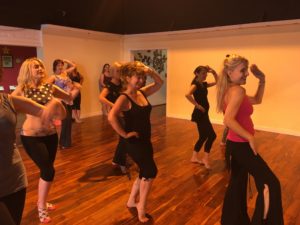 I teach a weekly class and generally our focus has been around learning a new dance to perform at a Hafla or other performance opportunity. I work in blocks within a term so a dance could be worked on between 6-10 weeks.
This term I decided to delay working on one dance all term, as I was concerned that not everyone wants the pressure of performing or can commit every week for the whole term. I also wanted to work on different props in taster sessions before committing to a longer choreography to see how they feel. The sessions have “mini” choreographies so its not just technique and we are improvising at the end of each session. The girls can then decide if they would like to turn one of the sessions into a dance they can perform at a later date.
I have to admit this has been a lot harder for me in terms of planning than having one dance to work around over the weeks! And I am itching to get going into one dance in more depth!
As a teacher one dance per term is so much easier to plan for in advance and it gives the girls the opportunity to get to know the music really well and in turn develop their musicality, flow and technique within the context of a particular style. Quite often at the beginning they think they will never learn it all in time, but it’s amazing how quickly it develops each week and before you know it we have reached the end with a great sense of achievement.
I switch from creating my own choreography from scratch to adapting a choreography I have learnt from a workshop or inspiration from UTube. If I use another teacher’s material, however small, I always give reference to it to the students at the time and if it’s performed. I like it when the girls offer up their own ideas to be included and am not precious about changing it to work. I have learnt that technical ability is important to those who want to achieve it, but that its more important that every one enjoys the dance and is challenged to within their own ability.
I love to improvise in my personal dance, but as a teacher my brain definitely works better planning around choreography and have come to appreciate how I enjoy developing a dance for a longer period. My body and soul may hear the music and be able to express it through dance for myself, but to pass that on to my students I really need a framework of a planned choreography and research to give my students the best experience.
Susan Reid, Jersey Channel lslands, JWAAD Teacher & Mentor
Susan has been the sole JWAAD Teacher based on Jersey for several years (soon to be joined by another) and helped develop the dance scene there. Susan completed her Mentor training last year so can now mentor students through the Personal Development Programme.
Josephine Wise & the JWAAD Legacy
Josephine Wise is one of the UK’s leading exponents of Egyptian dance, and is a leading international performer and teacher. Her style is known for its authenticity and deep expression. She has been in demand for her accessible and precise teaching style for over thirty years, and the depth of her knowledge is a huge asset to the UK dance scene.
Early Training
Josephine Wise was born in London, which has always been a great dance hub, and has huge opportunities for dance development. As at teenager and young adult she studied European style Contemporary Dance with Ernest Berk who, along with Laban, continued a legacy passed down from Isadora Duncan and Mary Wigman. Her training from Ernest included Classical Ballet, mime, drumming and elements of Japanese, Spanish and early 20th Century expressive improvisation. Jo performed in experimental Contemporary Dance companies and specialized in performed improvisation as well as lyrical choreography.
During her early twenties Jo went on to study Flamenco and Jazz dance, along with elements of African and Far Eastern styles, before discovering Middle Eastern dance and music in 1981. She trained with Wendy Buonaventura and Suraya Hillal for three years, before going to Egypt to see and study her new dance form in its country of origin. She saw Fifi Abdou and others onstage, and asked performers to teach her what they knew. Her dancing developed radically during this time, and she created her own style, using elements of Baladi from observing dancers such as Fifi, Suheir Zaki and Tahia Carioca, and Oriental from Mona Said, Samia Gamal and others. Her folklore was gleaned mainly from Mahmoud Reda and Benat Maazin.
Performance Work
Jo began performing in cabaret in 1983, and spent a couple of years dancing in Greek and Turkish restaurants, before graduating to Arab nightclubs. There were seventeen of these at their height in London in the ‘70’s and 80’s, so there was plenty of work. Jo danced at the Omar Khayam, the Kitkat club, Gallipoli, Arizona and others. Her dancing was particularly loved by Prince Khaled and others of the Saudi and Kuwaiti royal families, and she danced at many private parties for them. She also danced for many high society weddings in the lavish hotels in central London including Le Meridien, the Sheraton and many more. She was flown to the Middle East to dance at weddings for royal and multimillionaire families and once for the mafia!
Since 1995 Jo has performed at hundreds of theatres and festivals, in London, Edinburgh, San Francisco, Berlin, Cairo, Oslo, Tel Aviv and a vast number of other cities. She has performed in the UK, Germany, the USA, France, Italy, Norway, Denmark, Cairo, Israel, Spain, Belgium and more.
Creating a Style
The style that Jo developed for her performances is unique and has a number of elements. Her skill comes in the form of an exquisite flow of moves, coupled with superb isolations that look completely effortless. Having wonderfully elastic muscles and a fabulous control of each part of her body enables her to combine any number of elements in her dance. The power and drama she creates is born of an emotional nature unleashed on the audience, giving them access to her inner thoughts and expressing a subtlety of feeling that can hardly be expressed in words. However, it is her humour that draws the audience in, and reveals a humanity and a connection that few can resist.
Dance Companies
In 1989 Jo developed her first dance company ‘Sharqi’. They performed at Covent Garden International Dance Festival and other festivals around London and the south of England. They worked with live tabla, and improvised onstage as well as performing Jo’s choreography until 1992.
From 1993-2004, she was Artistic Director of ‘Masriat Egyptian Dance Company’, a new project with bigger ambitions. She also performed as soloist with them at the Place Theatre, Lilian Baylis Theatre, Jacksons Lane and tours around the UK. During this time she also choreographed works for theatre and opera, including Bizet’s ‘Djamila’, which was performed at the Royal Opera House and in Villa Ephrussi, France.
Then in 2007 she formed a new dance company ‘Johara Dance’.
Between 2008 and 2015 she choreographed three full length shows for them:
- ‘Elemental’ based on the four elements
- ‘Hoochie Coochie Girls’ about those who live on the margins of society
- ‘The Mirror’ a dark retelling of the Snow White story
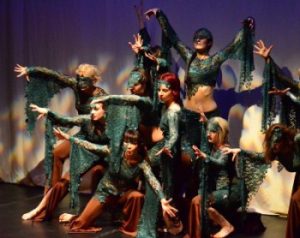 Johara Dance has toured the UK and northern France, and has performed at Sadlers Wells Lillian Baylis theatre, Jacksons Lane and the Bloomsbury Theatre in London.
Jo choreographs authentic Egyptian style works for Johara Dance and for classes and workshops, but she also creates a fusion of styles, mixing Middle Eastern, Flamenco, Latin, African, Hiphop, and Contemporary, for a dramatic and unique effect.
Events
JWAAD Summer Residential
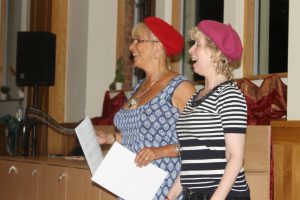 The first event to be developed by Jo was the annual JWAAD Summer Residential, which is a week-long intensive, in which the participants can attend dance classes all day, learn choreography, take part in a show, shop for new costumes, party and join in extra sessions on anything from costume making to makeup to wacky fun sessions on different dance subjects. There’s also a swimming pool and great food! The first Summer Residential was in 1990, and it’s still going strong. It is now in its 28th year.
Fantasia Festival
Between 2000 and 2015 Jo ran the Fantasia festival, London’s festival of Middle Eastern dance. For the first 10 years it took place twice a year, and after that was once, to make room for other events. It was the first festival of its kind in the UK, with a weekend of workshops, a huge souk for shopping, a show on Saturday night and sometimes a competition. The Fantasia festival is now up and running again, with JWAAD Belly Dance Training at the helm.
The International Bellydance Congress
This enormous event ran in 2007 and 2009, and had around 1000 dancers attending. Stars came from around the world to teach workshops and dance in huge gala shows each night. These included Fifi Abdou, Raqia Hassan, Randa Kamel and many more….
Singing
Jo is a singer-songwriter, with a CD coming out in 2017. She writes songs about the human condition, with humour and insight. She has a four-piece jazz band and they tour the UK, delighting audiences everywhere.
******************************************
Development of Teaching
Jo has taught dance, including Contemporary, Jazz and Dance Therapy for mental health, since 1979. She has taught in several schools and colleges, and four hospital psychiatric wards as part of the occupational therapy departments.
She started teaching classes in Bellydance in 1983 in London, and since then she has taught classes and workshops all around the UK and at festivals and events in many parts of Germany, France, Italy, Norway, Denmark and several other countries.
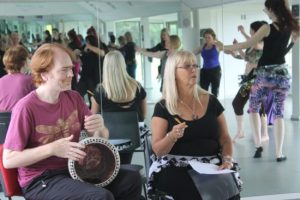 Jo teaches her own exceptional choreography, precise technique, improvisation, performance skills, working with live music and more. Her Professional Performance Course, which runs every Summer at the JWAAD Summer Residential, is attended by a number of well-known dancers, often the best in their city or country.
The Method
During her teaching career, Jo has developed a precise and accessible way of teaching, enabling dancers to learn without stress and to develop their skills and creativity. She uses elements of the way she has learned from others, but has developed a unique method of training. This method divides isolations up in a way that teaches the dancer to control different sets of muscles at different times, without strain or over-working them. The result is a dancer with control but also with a flow and a relaxed look to her dancing that is perfect for drawing in an audience and being creative in her own right.
Jo is a demanding but entertaining teacher who can get the best out of the students in front of her. She teaches one-to-one sessions to the highest professional level, and is exceedingly proud of all her protégés. Many of the best dancers in the UK have studied with Jo, along with more from around the world.
Creation and Development of JWAAD
In 1990, Jo set up the Josephine Wise Academy of Arabic Dance (JWAAD), to oversee all courses and classes from beginners to advanced/professional level. This was a busy year, as she also set up the annual week long JWAAD Summer Residential in Hertfordshire, a week-long intensive, in which she taught and brought in other Middle Eastern Dance teachers, to develop the skills of student dancers.
 In 1993 Jo qualified as a teacher of the Alexander Technique, and as well as working as an Alexander teacher, she added the theory of working with release in the muscles to her dance teaching. During this time she became aware of shortcomings in the level of Belly Dance teaching in the UK, and in 1995 she set up the first JWAAD Teacher Training Diploma course with Maggie Caffrey, who was Laban trained and an experienced teacher. Between them they were able to use their previous training and experience to develop a comprehensive course that included elements of anatomy, physical training, background history, music study and teaching methods. The course was a huge success in the UK, and after Maggie retired, the course continued with Kay Taylor taking over her role. Jo and Kay worked together to update the course for the 21st century, and divided it into the four separate elements you can study today.
Since the creation of JWAAD (now JWAAD Belly Dance Training) 90 dancers have received the full Diploma, and over 300 more have studied on four stand-alone courses in Safe teaching, History & Culture, Understanding Music, and Creating a Performance. Qualified teachers now teach all over the UK, Europe and as far afield as Australia.
Passing On the Legacy
JWAAD Belly Dance Training has created a community of teachers and dancers, provides a free resource area for all teachers who study with JWAAD and encourages mutual support of events and courses. JWAAD teachers know they have a support group and a career path they can pursue if they want to. They may start by teaching beginners and improvers, but they can work their way up to being a Technique Assessor/Mentor for other dancers, and even become a Teacher on the accredited courses.
The continuation of good teaching of this wonderful dance form is of huge importance to all of us at JWAAD Belly Dance Training. Kay Taylor, Gwen Booth and Yvette Cowles joined Jo to make the Academy and its courses into something world-class. The courses are all accredited by the One Awards, and we are proud of the progress both we and our trainees have made.
Facebook – Love it or loathe it???
I have been thinking about the pros and cons of Facebook, the behaviours that people display and things people post for some time. My last blog triggered so much debate that I felt the need to explore this phenomenon.
My partner and I love Facebook – we post pictures from nights out, on holiday …. As well as lots of belly dance stuff. Belly dance is an integral part of my life so everything merges. I am passionate about it (some people would say obsessed) – as well as being my hobby, it is my full time job. Poor Stuart has a lot to put up with.
I use Facebook as a way to keep in touch with friends who I rarely see and as a promotional tool. I have several Facebook pages – my personal one, Farida Dance, Farida Adventures, JWAAD belly Dance Training. And then several groups for people interested in specific things: ‘Shimmy up North’, groups for my different classes, a Fantasia group. These have more interaction – a way for people to ask questions, share travel or accommodation.
We have just launched a new Farida Dance web site and a new Bellydance Now website. These are completely different businesses. Farida Dance is my business which has grown and diversified over the years. Christine (Lucretia Katt on FB) tends to manage this and the Farida FB pages. JWAAD is a company of which I am one of the directors. I am passionate about learning and personal development. In my opinion, JWAADs accredited courses are the best. Maybe I am biased and maybe I bang on about them …. But I am as entitled to my opinion as the next person. I manage this and the JWAAD FB page with contributions from others.
I see the Facebook phenomenon as more positive than negative ….. BUT I can see how it can undermine. Generally I post ‘good news’ – ‘feel good’ factor stories and pictures. I try to be considerate in my wording of posts – though sometimes I get it wrong. Facebook is so instant. There are times I have skimmed over something, commented on it, then realised I have slightly missed the point. Or if I had read all the other comments, I could have written a more informed reply. I try to take a step back and not comment straight away ….. or make sure I read everything first.
Many of us have access to FB on our phones …. making it even more instant. You can comment when out and about, you may have had a few drinks or maybe you have woken in the middle of the night and got into the habit of checking your phone. With rebuilding the websites the main aim was to make them mobile friendly as so many people live through their mobiles these days. How things have changed!
Sometimes people write posts when they are feeling down – and it is nice to see that generally folks get very supportive comments from the FB community when they are having a difficult time. I am quite a private person in this respect so tend not to ‘share’ the bad news in such a public domain. We are all different though and neither is right or wrong – it is just what is right for you as an individual.
Posts written in anger are possibly the most dangerous! I have been guilty – but try not to ‘post in anger’. Give yourself time to think things through. Sometimes a rant about general life is fine but if it is about individuals or situations or commenting on something you feel strongly about, think before you post. THINK: Is posting on FB the best way? Might a private message be a better way of dealing with it? Or even, heaven forbid, talk to the person.
The blog I wrote about ‘Haflas – Definition & Etiquette’, I wrote it on www.jwaadtraining.uk and thought it could be of interest to people so shared it on several FB groups. It generated a strong response where the person had misunderstood and thought we were advertising a course about hafla etiquette for which people would have to pay. No one is charging extra money – it was a discussion blog to raise awareness of issues and behavior that I had observed from going to many haflas. A prime example of not reading things closely before responding. It was great that many people commented on the post pointing this out. And lots of people commented adding their own experiences which has been very interesting to read. Though the JWAAD blogs will sometimes be about our accredited courses, they are more often information or discussion pieces. You can always subscribe to the blog on the web site and find out for yourself.
Written by Kay Taylor 02.01.2018
Hafla – Definition & Etiquette
I love haflas!
I have been to hundreds over the years. From small local events with 20 or so women ……. to bigger events with a few hundred. So, how do you define a hafla – and what makes a good one?
Hafla – Arabic for ‘Party’. Haflas in the UK have become more about performing. A chance for classes to show the choreography they have learnt through the term. An opportunity for soloists to strut their stuff! From those new to performing to experienced professionals. For me, a hafla should be about inclusivity and encouragement. It is also important to allow time to boogie. Time for social dancing. No choreography to think about – just have a bop with your friends.
What makes a good hafla?
- Friendly atmosphere
- Well organised
- Good balance of performing and boogie time
- Runs on time
- Good range of music to dance to
- Good range of performances
- Good sound quality / volume
- The space / venue is set out well to create a good atmosphere
- The organiser/s are friendly and helpful
I have not only been to many haflas over the years, but organised many too. I love going to other peoples haflas that are well organised. I hate it when things run late and are chaotic. I love watching the performances – whatever level of experience, there is always something to enjoy. As an organiser, you have to think of all aspects of the event and ensure they run smoothly. I have been to some haflas that consistently run late / are badly organised. I’ll go a second time to support it but if nothing has improved, I will not go back. If I pay money for a ticket, I have certain expectations. Even charity events should be run well – if you volunteer to run a charity event then you need to be well organised. Some haflas are more community events where everyone mucks in – these are often chaotic but in a good natured everyone working together sort of way that I quite like. They are the exception that proves the rule.
When is a hafla not a hafla?
When it is a showcase ……. when it is all about performing and not about having a social boogie.
Onto Hafla Etiquette
When students go to their first hafla, they are not sure what to expect and it is up to more experienced hafla goers to help set the tone. It can also be useful, if there is a programme, to put a section in about hafla etiquette. Or, for the compere to encourage the audience to be supportive. At haflas, many of the audience will also be performers – so balancing performing needs and audience expectations needs consideration.
- Non performers
- Be encouraging of performers
- Clap, zhagreet, smile
- Have a boogie in the breaks
- Be inclusive – if someone is there by themselves, make the effort to include them
- Have fun
- Performers
- Be encouraging of other performers
- Allow yourself enough time to get ready before your performance – but don’t go too early or you will miss some performances
- Get changed quickly and rejoin the audience once you have finished
- Remember haflas are about sharing and supporting everyone
- Have a boogie in breaks – use them as a way of warming up before you perform
- Give other performers a bit of space in the changing area and always be friendly
- Enjoy performing …. and enjoy the other performances too
- Have fun
Watching dance is a great way of learning. A great way of getting new ideas and new inspiration. There seems to be an unfortunate trend of people only going to things that they are performing at. I notice that sometimes performers barely leave the changing room and hardly see any other dancers. I understand that some people need some space to get over their performance nerves ….. absolutely fine. But when you have danced, go and support the other performers.
Most haflas – and showcases, the performers make up 50% of the audience – so if everyone stayed in the changing room, it would make for a very small audience.
If you go and see a show …. as opposed to a hafla or showcase, this is different. The performers are backstage and the audience out front.
So, next time you go to a hafla think of all the points above and be as supportive of everyone as you can. If you are organising a hafla – think of how you can create a great hafla that will have people coming back every time.
These are my thoughts on the matter …. purely subjective. If you there are aspects I have missed, drop us a line and I’ll add them in. Kay jwaadtt@mac.com
Festive Greetings
Seasons Greetings from the JWAAD team.
Whatever you are doing, we hope you have a wonderful time.
Did you know …….. Christmas trees have become quite a ‘thing’ in Cairo. When I asked my friends they said ‘But they are New Year trees’. That sort of made sense …….
If you celebrate Christmas ….. have a very merry one.
If you don’t ….. enjoy the festive season and have a great New Year.
Whatever you do ….. keep dancing!
Are you looking to...
What's happening
Posted on 02/12/2024 by Kay Taylor
Meet Jamilah Aziz
I am delighted that Jamilah is joining us to teach at Fantasia 2025. Since...
Posted on 02/12/2024 by Kay Taylor
Meet Ishtar: aka Dorte Evelyn
Meet Ishtar ak Dorte Evelyn by Kay Taylor I love to find out more...
Posted on 13/11/2024 by Kay Taylor
Meet Josephine Wise: founder of Fantasia and JWAAD
Meet Josephine Wise by Kay Taylor Josephine Wise entered my life in the 1980’s....
Posted on 13/11/2024 by Kay Taylor
Meet Levana: organiser of Etoiles d’Orient and amazing teacher / performer
Meet Levana by Carmen Tormo I met Levana for the first time around 2018....
Posted on 13/11/2024 by Kay Taylor
About Oxana Bazaeva
About Oxana Bazaeva Ossetians or Ossettes are an Iranian ethnic group of the Caucasus...
Posted on 13/02/2023 by Kay Taylor
Free Zoom for teaching
Dear Dancers We are about to start our next round of teacher training. Our...
Get in touch for more information